
When the VA evaluates a disability claim, it is not making a subjective judgment about how much pain you experience, how long you served, or how significantly your condition affects your daily life in general terms.
It is applying a regulatory framework.
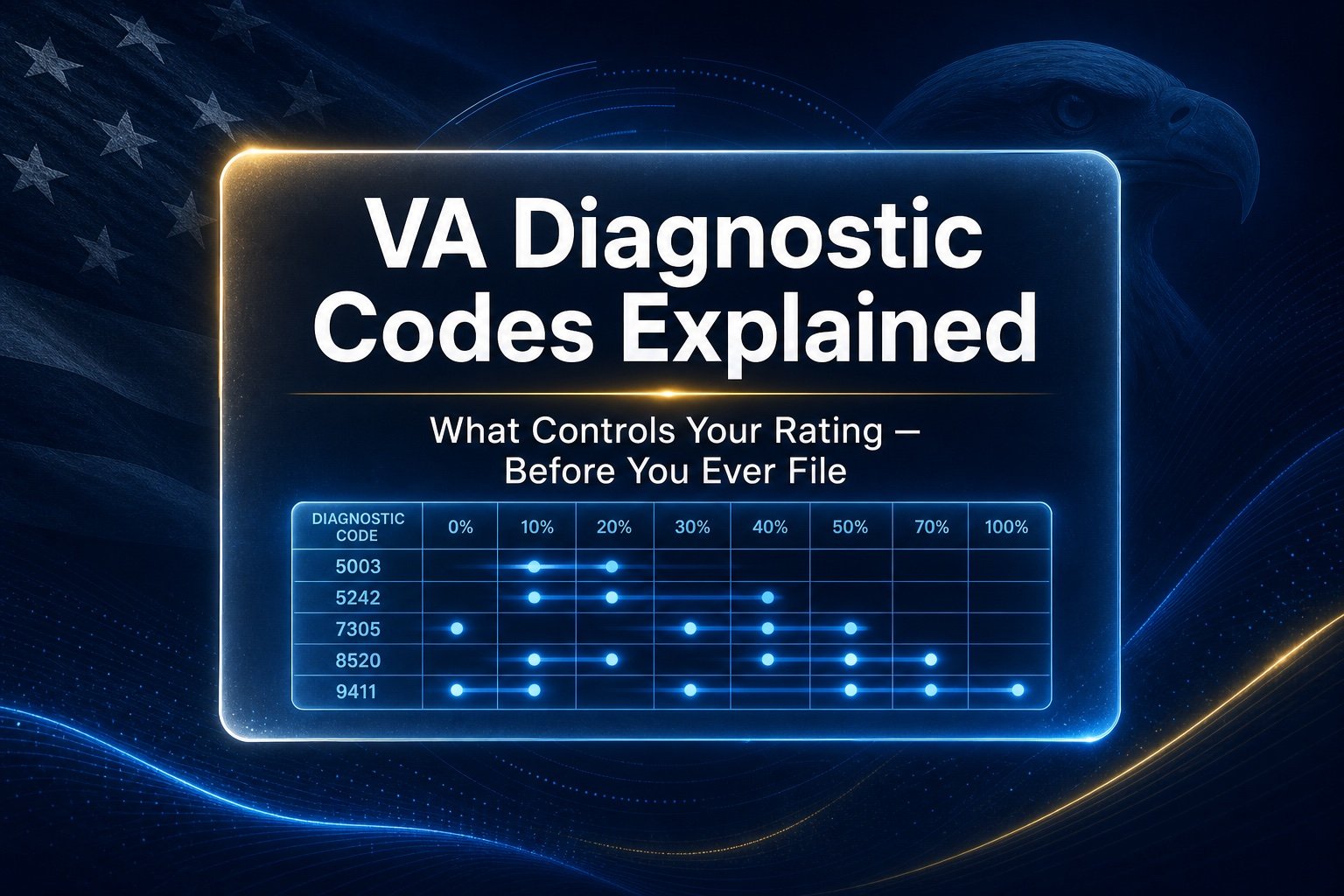
That framework is called the VA Schedule for Rating Disabilities – published in Title 38 of the Code of Federal Regulations, Part 4. And the mechanism that drives it is called a VA disability Diagnostic Code.
Understanding what a Diagnostic Code is and how it functions within the VA evaluation process is one of the most important things a veteran can learn before filing a claim.
What a Diagnostic Code Is
Every ratable condition has a Diagnostic Code (DC) – a numerical identifier assigned by the VA that corresponds to a specific set of evaluation criteria. Those criteria define exactly what symptoms, clinical measurements, and functional limitations correspond to each disability rating percentage: 0%, 10%, 20%, 30%, and so on up to 100%.
The VA rater evaluating your claim is required to assign a rating based on how your documented evidence aligns with those criteria. Not based on how you feel in the exam room. Not based on the examiner’s personal impression. Based on what is documented – and whether that documentation speaks the language of the Diagnostic Code.
This is a critical distinction. A condition can be real, severe, and legitimately service-connected, and still receive a lower rating than warranted – simply because the documentation did not address the specific criteria the Diagnostic Code requires.
Real Examples From the Rating Schedule
DC 6847 – Obstructive Sleep Apnea
A 50% rating under this code requires documented use of a breathing assistance device such as a CPAP machine. If your sleep apnea is severe but your CPAP use is not clearly reflected in your medical records, that 50% threshold may not be reachable based on documentation alone – regardless of the actual severity of your condition.
DC 8100 – Migraines
A 50% rating requires documentation of “very frequent completely prostrating and prolonged attacks productive of severe economic inadaptability.” Every word in that phrase is clinical and regulatory. If your records describe frequent headaches but do not capture the frequency, duration, prostrating nature, and economic impact in those terms, the criteria for that rating threshold will not be met on paper.
DC 9411 – PTSD
Evaluated under the General Rating Formula for Mental Disorders. Each rating level – 30%, 50%, 70%, 100% – corresponds to a defined level of occupational and social impairment. The documentation must establish that level of impairment clearly and consistently across your medical record to support each threshold.
These are not obscure edge cases. They are the three of the most commonly filed conditions in the VA system – and misalignment between documentation and Diagnostic Code criteria is one of the primary drivers of under-ratings and denials across all three.
What This Means for Your Claim
If you are preparing to file a VA disability claim – or if you have already filed and received a rating that does not feel accurate – the first question to ask is not “did I do something wrong?” The question is:
Does my documentation address the specific criteria of my Diagnostic Code at the rating level I believe my condition warrants?
That is a technical question that requires a regulatory answer. And it is exactly the kind of question the VetIntel Solutions TacticalAdvantage™ educational frameworks were built to help you answer – for your specific condition, in plain language, before you file.
Your Next Step
If you have not yet assessed where your documentation stands relative to your Diagnostic Code criteria, start with the ReadinessScan™.
It analyzes your inputs against VA rating standards and generates a personalized BattlePlan Readiness™ Summary Report with your Readiness Index™ Score – showing you clearly where your documentation is aligned and where the gaps are.
Take the ReadinessScan™ ($29): https://vetintelsolutions.com/strategic-assessment/
Then explore the condition-specific TacticalAdvantage™ framework for your claim: https://vetintelsolutions.com/store/
VetIntel Solutions™ is not affiliated with the Department of Veterans Affairs. This content is educational in nature and does not constitute legal advice, claims filing assistance, or representation services of any kind.